

Whose Story is This
Twenty years after I was violently mugged (in another country), I am still trying to write it down

This is an odd piece for me to write. Not because the experience was insignificant - it was transformative - and not because the story is uninteresting. It’s hard for me to tell because I’m not sure if I trust myself to make sense of it, even now, twenty years later. The layers of complexity that this story straddles are vast and confusing, and at times I find myself pulling at threads and finding the story meander one way and then take a completely different turn another time. I’ve told versions of it where the lesson was about finding my path. About connecting across race and country of origin and gender. About not letting fear stop me. None of them have been quite right. Each of those versions contain a desire for approval, a greed for cohesive answers, that still results in me controlling the narrative.
So I’m going to try to tell the facts as best I can remember them, and let the meanings stay unsettled. Because the story is mine and it isn’t. Twenty years on, I still don't know what the story is about. I only know that it has stayed with me.
What happened: I was dragged by a car in West Africa, and I developed PTSD.
First let me explain that I was in Ghana after graduating from college where I majored in theater. I was part of a collective of young theater artists and hip-hop artists from New York who were studying how the two forms connected and overlapped. This was in 2006. Freestyle Love Supreme had formed a couple years earlier, and the Hamilton craze was still a decade away. I didn’t come from hip-hop culture. I was there almost by accident, or I was there by choice, and that’s even more complicated. I gave myself permission to be there, in the way that white American 24 year-olds give themselves permission to be everywhere. The word for that is colonizer, and I was one, even though I would not have used the word about myself at the time.
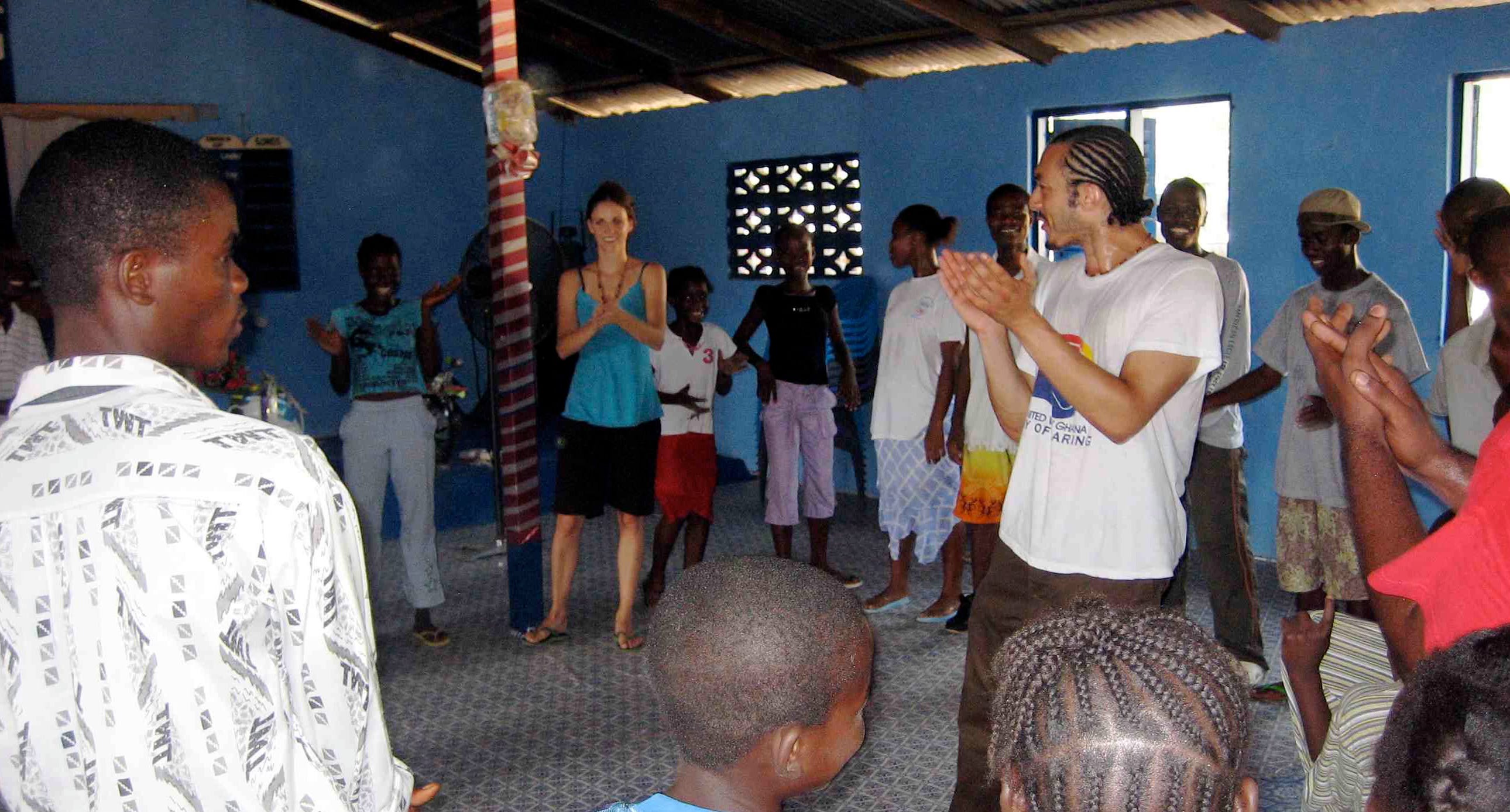
I had arrived in Ghana two weeks earlier to participate in the six-month long project exploring how hiplife, a combination of Ghanaian highlife music and American hip-hop, could be integrated into theater. Myself, my boyfriend (an Indian American hip-hop artist), and one of my best friends B (an African American interdisciplinary musician and actor) all had recently graduated and were assisting a professor teaching at the University of Legon in Accra. Additionally we worked with this professor and a larger hip-hop theater collective running and participating in educational theater workshops at a Liberian refugee camp about an hour away. None of that work had started yet.
I gave myself permission to be there, in the way that white American 24 year-olds give themselves permission to be everywhere. The word for that is colonizer, and I was one, even though I would not have used the word about myself at the time.
It was dusk in the uncrowded outskirts of Accra near the university, and I was walking on the side of the road a step ahead of (or a step behind) two other male friends in our theater collective. It’s a little fuzzy now. A cab drove toward us, and I remember being startled because before I realized what was happening, a hand reached out the passenger side window, grabbed my bag, and the car sped off. I got caught in the bag strap, and I got pulled backwards away with the car. I said, oh… excuse me. As if it had been an accident. I cringe when I think of that fawning moment. How falsely polite, how outside my worldview this experience was. My sandals slipped off, and I tried to stand but the car was moving too fast. I remember pain as my feet blistered from friction on the dirt road. I remember yelling - I think all of us were yelling. I registered that the men in the car didn’t want me there, but I couldn’t get away until they let go of the bag. I was dragged back and then I must have looped my arm inside the open window and pulled myself up onto the side of the car because I remember being face to face with the passenger holding my bag. He seemed scared too, or angry or alarmed. He told me to let go!, and I demanded you let go! of the bag because I was stuck.
My tube top had slipped down, my back had scraped the road, and I was bare-breasted. Even in that moment I registered what the composition would mean to anyone watching - the white woman, half-undressed, screaming at Black men. I was inside a dangerous frame, and some part of me was already cataloguing it.
The snapshots I was noticing - white, Black, woman, men, American, West African - were real facts and they were shaping what was happening. They were not the wrong facts to notice. They were just not the only ones. There were also two men whose plan had gone wrong. There was a bag strap I could not get my arm out of. There was the dirt road, the dusk, the friends behind me. There was my own body, which had not yet figured out that it was in danger. My awareness of the situation was incomplete, and it was loud. So loud that it made many other things harder to hear after the incident.
I registered that this might be the way I died, and if I didn't die, it would be a kick-ass story. That was the phrase that crossed my mind. A kick-ass story. Like I was hero in an action film. Even now, twenty years later, that's the line I cannot get past. The instinct, in the most dangerous moment of my life so far, to start narrating it.
This all probably took place in a very short amount of time. It felt like a long time. The man must have thrown me and the bag off the car and sped away. I think I blacked out. I remember lying on the side of the road and hearing one of my two friends repeating my name over and over with so much worry and concern. I kept on repeating that I was worried about my head.
We got in another cab that I later learned had pulled over out of concern when he saw what had happened. I didn’t want to get in the cab, but I didn’t say that. See I was convinced that maybe this driver knew the other driver and there was a larger plot to hurt me. I didn't say it at the time because it sounded crazy. And because - was I being racist? Twenty years later I still don't know. I don't know if I was being a frightened 24 year-old who had just been pulled by a moving car, or a white American making the most predictable mistake a white American could make in West Africa, or both at once, in the same instant, with no way to separate them. This is where the story always gets unwieldy. This is where I always lose track of which version is the true one.
The instinct, in the most dangerous moment of my life so far, to start narrating it.
What happened next? My friends took me in the cab to the hospital. Got a CT scan, cutting the line in front of many Ghanaian people who had been waiting. My body felt like it had been tenderized: a headache reaching up from the base of my skull, deep scrapes across my back, and skin torn off the bottoms of both feet that would take months to heal. Spent a few nights in the hospital. Concussion protocol, tending the gashes and wounds. It was a very peaceful experience at the hospital, and I felt grateful to be alive. I didn’t tell my parents what happened because I feared that they would encourage me to come home to America. I think I wanted to go home, but I also was trying to control the situation. I was two weeks into my six-month experience. It wasn’t time to go home yet.
Things didn’t start to go off until I moved back into our rented apartment in downtown Accra, with my boyfriend and B. What I now understand clearly to be PTSD, I started having panic attacks any time we had to go outside after dark, or when walking along a street, or when negotiating the fees for cabs. I had paranoid thoughts that everyone knew who I was, all the drivers, all the people who called out to us on the street, who were selling food or offering services as is normal in the street culture of Accra. I felt like these street vendors were laughing at me, seeing me as a target, as a weak, vulnerable, stupid, generic white woman. Seeing me as someone to exploit or as a means to an end. Or seeing me as someone to exact revenge upon for all the harm my whiteness and colonialism had inflicted upon this part of the world. Or not seeing me at all, which somehow almost felt worse. I blended into the scenery, invisible and impotent, a tag-along to my friends. It was bad. It was very very bad.
My mental state was deeply messed up, and still I was trying to continue to do the projects we were there for, collaborating with Ghanaian hiplife students, and creating theater with refugees from the Liberian civil war, many of whom had survived things I will never write here because they are not mine to write - and many of whom were extraordinary artists and collaborators. I began playing the trauma Olympics in my mind. I told myself that I had no right to panic after my incident. Nothing had really happened. I was alive. I was fine. Not when I could see people around me who had experienced and lost so much more. I am still not entirely sure I was wrong about that. I am also not entirely sure I was right. The trauma Olympics is a real trap, but so is using other people's larger pain as a reason not to feel your own. I was 24. I had no internal architecture for what had happened. I did not know how to witness the larger suffering around me while also honoring my own, so I did neither, and I made everyone around me carry it.
My friends experienced the worst of it. The middle of the night sweats, screaming, crying, backing into a corner hyperventilating. My rapid weight loss as I struggled to eat, to take up space. The anger and irritation at routines and schedules getting delayed, the inflated sense of jealousy over the time they were wanting to enjoy at music clubs or bars or restaurants. I felt so alone, and I made it even worse. I felt needy, selfish, and scared. I was mad at myself for feeling all of it. For having this burden. The two people who I could have been mad at, the driver and passenger of the cab who grabbed me, I forgave magnanimously, as if settling some karmic debt that my possible ancestors had accrued long before. (My Catholic school education can be thanked for the ability to so easily and superficially forgive and turn the other cheek, to feel such literal guilt, to self-flagellate and take on such a narcissistic over-responsibility.)
I was living two lives, one in the world of the university and at the refugee camp where I masked my symptoms and had a genuinely meaningful, educational, and connected time, and another at home and on the street where I shriveled into my most limited self. I tried minimally to get help from mental health practitioners, one person recommending chamomile tea for my anxiety, but I couldn’t be truthful to them if I wasn’t even able to be truthful to myself. I sublimated it all. I kinda thought I was doing fine, if you ignored the paranoia, the fear, the hypervigilance, the codependency and self-harm.
We took a trip to Elmina Castle on the coast of Ghana where for centuries enslaved Africans were pushed through the Door of No Return, the threshold through which an estimated twelve million people were forced onto ships to cross the Atlantic. My African American friends were doing something I could only watch. They were confronting a deeply violent fact of their inheritance in the place where it happened, holding it, finding a way to carry it home with them. It was sacred work, and it was not mine. I knew that even at the time, and yet I still found a way to make the visit about me.
I made it about me silently, in my own head. I was scanning my body for sensation. I was tracking my proximity to the violence as if proximity were participation. I was looking for a way to belong in the grief that was happening in front of me, even though belonging there was not the point. I wanted my trauma to make me a participant in this history rather than an inheritor of its benefits. Nothing about my pain belonged at that site.
It is embarrassing to write that now. It is more embarrassing to remember that I did not know it was embarrassing at the time. I thought I was doing the work. I was doing the opposite. The most predictable version of the white woman in West Africa is the one who believes she is the exception. I was not the exception.
The story doesn’t have an easy end. We finished our projects, I stayed the full duration of the trip, and we went home. I continued to have severe PTSD when we got back to New York, and I gripped onto my relationship even tighter. I became paranoid that I would get attacked on the street in Brooklyn, or that my boyfriend would die walking home from my apartment to his. I would leave my shift at the restaurant I worked at in the East Village and walk aggressively with my keys gripped between my knuckles. I took a self-defense course. I was a teaching artist in a high school in the Bronx doing improv and playmaking. The collective I had travelled with created a devised experimental theater piece where I wrote my character to be a woman named Les who had had her tongue cut out and had been pregnant for 100 years. Freud would have had a field day.
The most predictable version of the white woman in West Africa is the one who believes she is the exception. I was not the exception.
It took my boyfriend and I breaking up a few years later before I started therapy for the first time. I joined the Big Apple Playback Theatre company, where I learned an interactional form of improvisational theater and explored race and intersectional identity with other actors in the company. It was the first space where I encountered the term white narcissism - the way whiteness can position itself at the center even when it believes it is doing the opposite, even when it believes it is decentering, even when it believes it is engaging in care. The term landed because it described what I had done in Ghana. It describes what I still have to actively work against.
I thought about discussing it with my parents over the years, but I never did. They knew what had happened, but it’s not something I knew how to talk about at that point.
One ending to the story is that this incident led to my deep curiosity about mental health and half a decade later I started the path to become a therapist. And while that’s part of the story, it’s not all of it.
Another end is that I saw myself stripped of my privilege for the first time in the experience and its aftermath, and it was shattering. But that’s not really it either.
My friends were true friends. I’m grateful for them and their tolerance of me. I’m also sad for myself and how I had to make myself suffer so much more than maybe I could have. But who knows.
One night in Accra, my professor said something that has stayed with me for twenty years. You never know who your Buddha is. I have examined that sentence many times since. Were the men in the cab there to teach me something? Were the participants in our workshops? Was I there to learn from myself? Is it simplistic to even think that the universe might work in this way? I have come to believe that any answer would be reductive to the importance of just asking the questions. No answer gets me closer to the wisdom I seek.
My heart hurts for my 24 year-old self when I tell this story. It also hurts for everyone I asked to be my witness during that time. I'm not sure I have earned the right to tell this story even now. But I am still telling it, because the not-telling has its own cost, and because some stories continue to teach you for the rest of your life, and this is one of them.
Beautiful.
love this piece. thank you for sharing